From Ontbijtkoek to Office Bowls
How Dutch Food and Office Culture Have Evolved — Without Losing Their Soul
Clock Pepper Salt
12/30/20253 min read
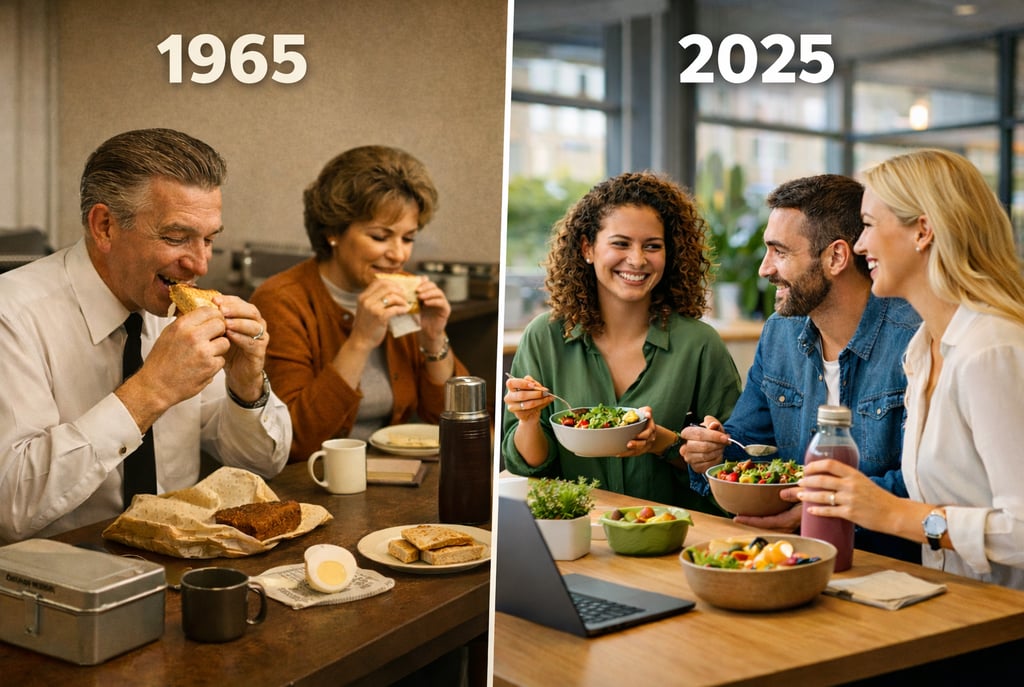
If you walk into a Dutch office today, you may see plant-based lunches, reusable bottles, flexible working hours, and teams eating together before heading home early.
Sixty years ago, the scene looked different — but the values underneath were remarkably similar.
The story of food in the Netherlands is not about dramatic reinvention. It is about continuity: simplicity, health consciousness, pragmatism, and grounded progress. Few cultures have managed to evolve across decades while remaining so recognizably themselves.
That continuity matters — especially as modern workplaces rethink what culture, care, and connection really mean.
What Netherlanders Ate in the 1960s
In the 1960s, Dutch food was shaped by practicality rather than abundance.
A typical day of eating included:
Breakfast: Bread with butter, cheese, or ontbijtkoek — a spiced cake deeply rooted in Dutch culinary tradition, symbolising comfort, energy, and familiarity.
Lunch: Simple sandwiches, packed from home, eaten efficiently.
Dinner: The classic AVG meal — aardappelen (Potato), vlees (Meat) , groenten (Vegetables)— predictable, nourishing, and shared.
Meals were seasonal, local, and modest. Food waste was low. Portions were sensible. Eating was not performative — it was purposeful.
Office Culture in the 1960s: Structure and Routine
Dutch office life in the 1960s mirrored this approach to food.
Lunch was brought from home.
Workdays were structured and punctual.
Hierarchies were clear, but expectations were stable.
Employers showed care through security and predictability, not perks.
Food at work was not a benefit.
It was part of daily rhythm — quietly supporting productivity without demanding attention.
What Has Changed in Dutch Food Habits Today
Modern Dutch eating habits have evolved, but not radically.
Today, Netherlanders eat:
More globally influenced meals
More plant-based and flexitarian diets
Less heavy starch, more variety
With greater awareness of health, sustainability, and inclusion
Yet moderation remains. Even as variety has increased, excess has not become the norm.
This evolution reflects a broader Dutch mindset: adapt what is useful, discard what is not.
Office Culture Now: From Routine to Ritual
Today’s Dutch workplace looks very different:
Hybrid work is common
Hierarchies are flatter
Autonomy is higher
Work-life balance is actively protected
Food at work has shifted from routine to signal.
It now signals:
Care
Inclusion
Belonging
Thoughtfulness
Lunch has become one of the few daily moments where people still gather — not because they must, but because they want to.
The Modern Constraints Around Food at Work
This shift has introduced new challenges:
Hybrid schedules reduce shared moments
Diverse teams bring diverse dietary needs
Too much choice creates complexity
Office teams carry the operational burden
Food remains emotionally important — but logistically harder.
The risk is not doing too little.
The risk is doing too much without intention.
What the Netherlands Has Retained — and Why It Matters
Despite decades of change, some things have endured.
Simplicity
Dutch food culture resists unnecessary excess.
Health Consciousness
Health has always been practical, not performative.
Gezelligheid
Shared moments still matter — especially around food.
Ontbijtkoek remains a quiet symbol of this continuity. It represents comfort, heritage, and seasonality — a reminder that food can be grounding even in fast-moving environments.
Continuity as a Competitive Advantage
If any culture has shown that progress does not require abandoning roots, it is Dutch culture.
This continuity has supported:
Stable productivity
Sustainable work rhythms
Long-term wellbeing
Steady economic progress
Rather than chasing trends, the Netherlands has refined what works.
What This Means for Modern Workplaces
For today’s organizations, the lesson is not about bigger perks or trend-driven programs.
It is about intentional simplicity:
Food that brings people together naturally
Systems that reduce stress rather than add to it
Everyday rituals that reinforce culture quietly
Food does not need to be loud to be meaningful.
In Dutch culture, it never has been.
A Quiet Reflection
As workplaces rethink how to bring people together again — not by force, but by choice — there is something deeply relevant in the Dutch approach to food and work.
With balance.
With care.
With continuity.
Sometimes progress is not about reinventing culture — but about honoring it and adapting it thoughtfully for today.
At Clock Pepper Salt, we see food not as a perk, but as a daily rhythm — one that quietly shapes culture, connection, and performance.
info@clockpeppersalt.com
+31-681186536
A Clock Pepper Salt Company.
btw-id: NL005150091B25
© 2026. All rights reserved.